

If you’ve ever sat in a dental chair and heard the words “you need a root canal,” you know the feeling that follows. Fear. Dread. A dozen questions you don’t know how to ask.
Here’s what I want you to know: in most cases, root canals are preventable. And even if you’ve already been told you need one, it may not be too late to explore other options.
I’ve been practicing dentistry for over 20 years. For the first 15, I performed root canals myself — hundreds of them. I learned from the inside out why they fail, what drives patients toward them, and more importantly, what can stop that from happening in the first place.
This guide is everything I wish someone had told me earlier in my career.

What Causes a Root Canal in the First Place?
To understand how to prevent a root canal, you have to understand why they happen.
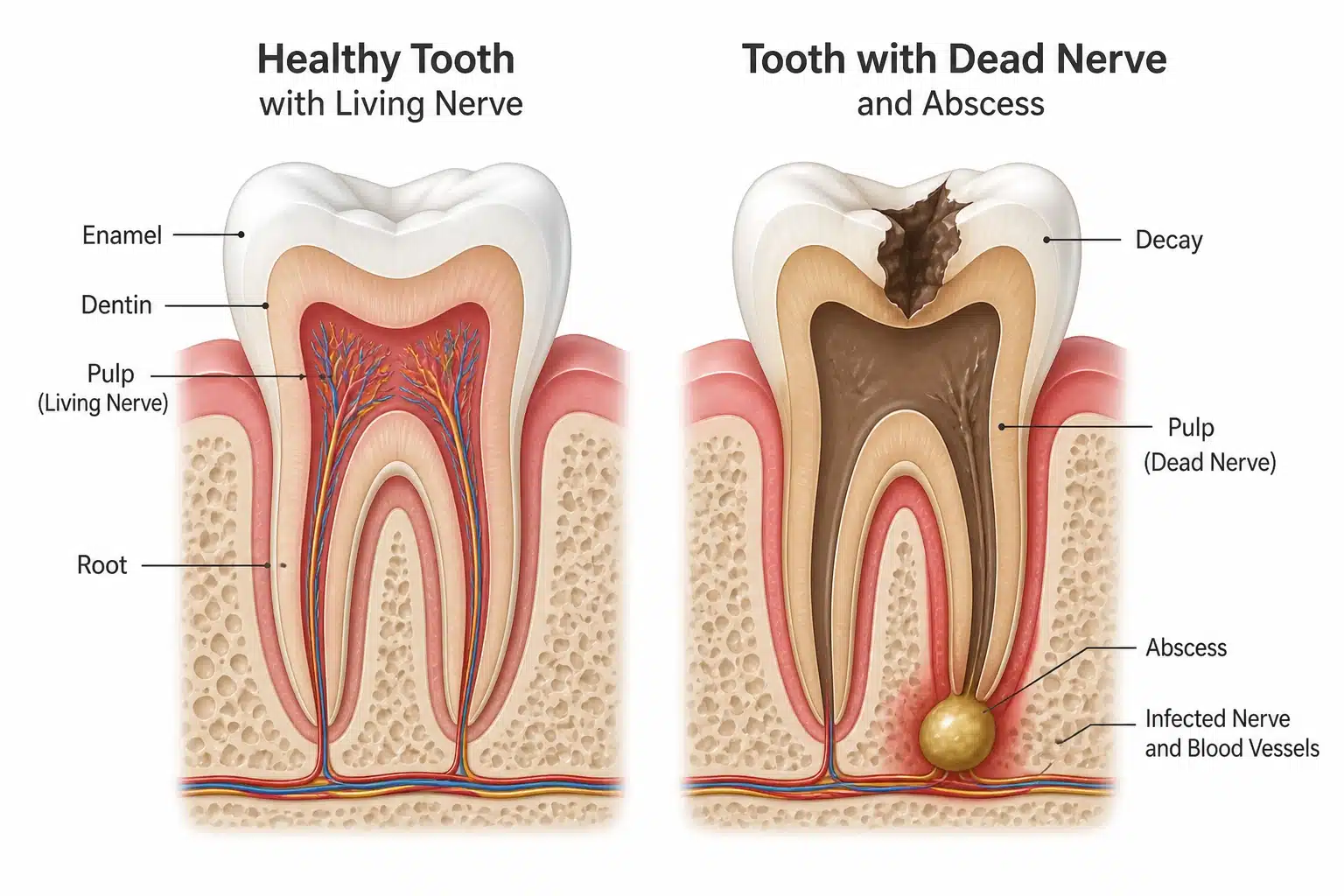
Inside every tooth is a chamber called the pulp — the soft tissue that contains the nerve and blood vessels keeping your tooth alive. It delivers nutrients, enables sensation, and gives the tooth its ability to heal.
When tooth decay is left untreated, bacteria work their way through the enamel and dentin toward that pulp. Once bacteria reach the nerve, inflammation sets in. The tissue begins to die. And where dead tissue lives, more bacteria follow.
That’s when severe pain starts. And that’s when most patients are told a root canal is their only option.
Once a nerve dies, bacteria find the dead tissue and multiply. That pressure builds. That’s what causes the severe, throbbing pain most people associate with a dental emergency. And that infection doesn’t stay local — it spreads.
As soon as the nerve is dead, your options narrow significantly. But if it’s still alive? You have real choices.
How to Prevent a Root Canal: What Actually Works
So how do you keep that nerve alive? Here’s what I recommend — and what we do differently at Total Care Dental.
1. Get the Right Diagnosis Early
Most standard dental X-rays only show you history. A regular X-ray reflects what’s been happening over the past several months — not what’s happening right now, this week.
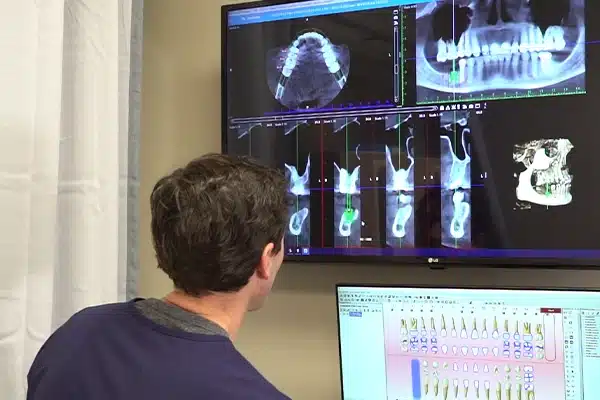
At Total Care Dental, we use a cone beam CT scan to get a full three-dimensional view of the tooth and surrounding bone. This lets us see:
- How close the decay is to the nerve
- Whether infection is present at the root tip
- How much healthy tooth structure remains
Early, accurate diagnosis is the difference between having options and running out of them.
2. Treat Deep Cavities Before They Reach the Nerve
Here’s something most patients have never heard: when a cavity gets close to the nerve, we don’t always have to go all the way through.
We use selective decay removal — cleaning the decay to a precise depth, then applying ozone therapy directly to the deepest surface to kill the remaining bacteria without touching the nerve beneath.
We then restore the tooth with a biocompatible material that supports natural healing in the surrounding tissue. Most of the time, the nerve heals. The tooth stays alive. No root canal needed.
This is where dentistry is going. And the results are remarkable.
3. Keep Plaque and Bacteria Under Control
The foundation of avoiding root canals is simpler than most people think: don’t let bacteria win.
- Brush twice daily to remove the plaque buildup that feeds decay
- Floss every day — cavities between teeth are one of the most common paths to deep decay
- Limit sugary snacks and acidic foods — sugar feeds the bacteria that produce acids that eat through enamel
- Use a mineral-rich toothpaste that supports remineralization of enamel
Good oral hygiene isn’t just about a clean smile. It’s about keeping decay from ever getting deep enough to threaten your nerve.

4. Protect Against Trauma and Fracture
Not all root canals start with decay. Many begin with trauma — a sports injury, a fall, biting down on something unexpectedly hard.
- Wear a mouthguard during contact sports
- Avoid chewing on ice or hard candy
- If you grind at night, a nightguard can prevent the hairline cracks that silently travel toward the nerve over time
A cracked tooth left untreated can allow bacteria to reach the pulp without ever going through traditional decay.
5. Support Your Body’s Ability to Heal
This one doesn’t get talked about enough.
A tooth with a living nerve inside a body with a strong immune system is far more capable of fighting off early-stage infection on its own. Nutrition is part of dental health.
- Calcium and Vitamin D support strong tooth structure and healthy bone
- Vitamin K2 helps direct minerals into teeth where they’re needed
- A balanced diet low in processed foods reduces the systemic inflammation that makes infection harder to fight
- Reducing sugar protects both your oral health and your overall well-being
The mouth is not separate from the body. A healthier body means a more resilient mouth.
What If You’ve Already Been Told You Need a Root Canal?
Don’t assume it’s over.
Before you schedule anything, ask your dentist one question: Has anyone tested whether my nerve is still alive?
A simple vitality test — done right in the office — can tell us whether the nerve is still responding. If your dentist hasn’t done this, you don’t have the full picture yet.
If the nerve is still alive, a root canal may not be necessary. Request proper imaging. Ask about alternatives. Get a second opinion if needed.
You have the right to understand all your options before agreeing to an invasive procedure.
When a Root Canal Becomes Unavoidable
I want to be straight with you here, because I think you deserve an honest answer.
Sometimes, a root canal really is necessary. When the nerve is already dead, when infection has spread, when a tooth has been left untreated for too long — at that point, options narrow.
I’ve lived this personally. When my son was 11, he was hit in the mouth by a baseball. He came around the corner spitting out teeth. One wasn’t salvageable. The other was fractured halfway down the root. My choice was to do a root canal — knowing it would eventually fail — or extract both of his permanent front teeth at 11 years old.
I chose the root canal. It bought him years until he was old enough for ceramic implants.
Root canals aren’t the enemy. They’re a tool — sometimes the right one, often not the only one.

The Biological Dentistry Approach to Root Canal Prevention
At Total Care Dental, root canal prevention isn’t a single procedure. It’s a philosophy.
We start with the right technology — cone beam CT imaging that shows us exactly what’s happening inside the tooth and the surrounding bone. We test every tooth to confirm whether the nerve is alive before making any recommendations.
When there’s a living nerve to save, we use:
- Ozone therapy to disinfect the deepest layers of decay without damaging the nerve
- Selective decay removal to clean to the right depth without going through
- Biocompatible restorative materials that support the tooth’s natural healing process
- Ongoing monitoring to confirm the nerve continues to recover
We’ve helped hundreds of patients who walked in convinced a root canal was their only option. Many of them still have their natural tooth — alive, functional, and healthy.
The Bottom Line
The best root canal is no root canal at all.
Most of the time, we reach that point because decay was caught too late, the nerve was never tested, or no one offered an alternative. That’s what we’re here to change.
If you have a deep cavity, if you’ve been told you need a root canal, or if you simply want the full picture of your tooth’s health — come in for a new patient exam. We’ll use the right imaging, test the nerve, walk you through exactly what we find, and talk through every option before any decision is made.
Because you deserve to know what you’re choosing before you choose it.
Ready to Find Out If Your Tooth Can Be Saved? Schedule a New Patient Exam at Total Care Dental.